The Long Game
What no one tells you about Substack Growth


There is a Substack success story you have probably read about a hundred times.
Writer quits the day job. Writer launches a newsletter. Writer hits 10,000 subscribers in six weeks and makes $100,000 a year doing it.
Good for them. I mean that.
The part that usually gets left out is that the writer already had a big audience before they started. The newsletter didn’t build the audience. The audience built the newsletter.
That is not most people’s story. It was not mine.
My early days looked nothing like the screenshots you see everywhere. Small numbers. Checking the subscriber count far more often than was good for me. Publishing anyway, and wondering,whether any of it was actually going somewhere.
Nobody warns you about that bit. How normal it is. How long it goes on for. How easily “slow” starts to feel like “failure.”
So let me say the thing I needed someone to say to me. You are probably not doing anything wrong. You are probably just early.
I have been writing on Substack for a good while now. I have watched what actually works, not in theory and not from the outside, but from inside the work. Testing things on my own newsletter. Watching what happened. Changing what didn’t.
And recently I put everything I wish I had known at the start into a book.
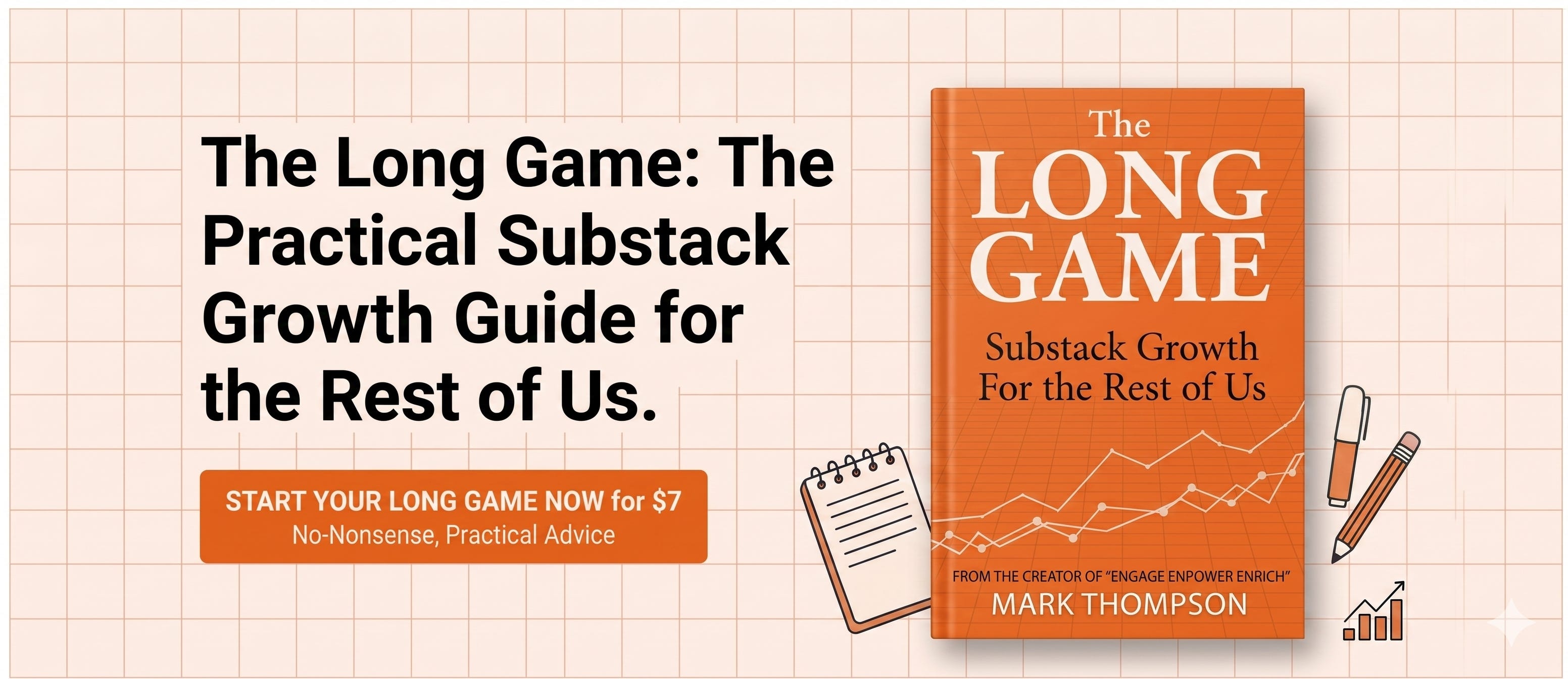
It is called The Long Game: Substack Growth For The Rest Of Us.
Not the version that assumes you already have an audience waiting. Not the one about going viral. The actual version, for writers sitting somewhere between zero and a thousand subscribers, trying to work out why all that advice they keep reading doesn’t seem to do anything when they try it.
Here is what is inside.
How Substack actually works as a system. Most writers only understand half of it. The other half is where most of the growth actually comes from, and almost nobody talks about it.
Your first hundred subscribers. The unglamorous version. No hacks, no borrowed audiences, just what works when you are genuinely starting from nothing.
Notes. The most underused growth tool on the whole platform, and I walk you through exactly how to use it in a way that drives real discovery rather than noise.
Writing that keeps people around. Getting someone to subscribe is one problem. Getting them to stay is a completely different one. The book covers both, because one without the other gets you nowhere.
How to ask for money without feeling like a fraud. If you have switched paid subscriptions on and have no idea how to actually talk about them, this is the chapter you have been waiting for.
What your numbers are really telling you. Because most people are reading them backwards and talking themselves out of something that was working.
Ten chapters. 10,000 words. Every single one ends with something you can go and do today, not just something to nod along to.
It is honest about timelines. It is honest about conversion rates. It does not promise you things that are not going to happen.
What it does promise is this. The writers who build something real on Substack are nearly always the ones who simply stuck around longer than everybody else. That is the long game. And it is far more achievable than the viral version, once you understand what you are actually building.
It is $7. Less than a couple of coffees.
If you want to keep reading after that, come and find me at The Systematic Writer, where I publish every week about what is genuinely working for writers at this stage. (paid subscribers get all my books, communities and courses for free)There is also a free community called The Inner Circle, over 750 writers comparing notes, if that sounds like your kind of thing.
But start with the book. It is the cheapest shortcut I can give you.